Fasten Your Seatbelt: Organizational Change with AI Continues to Accelerate
Posted by André Lit

I lived my life as an executive and consultant, implementing strategies, leading organizational transformations, and managing change projects. The first major project I worked on, a significant challenge, was at Globosat 30 years ago, when PayTV was entering the market and streaming was not even on the radar yet.
Constantly reading articles from large management consultancies, such as McKinsey, BCG, Bain, and Arthur D. Little, where I worked at the time, made me very anxious. As studies and research showed, for most of them, transformational projects did not work. Focusing on the past 20 years, I used AI to search for some of these articles by identifying the most relevant barriers that led to these failures, regardless of the consultancy. The graph below presents the results of this evaluation, with the 15 main barriers ordered by relevance (%):
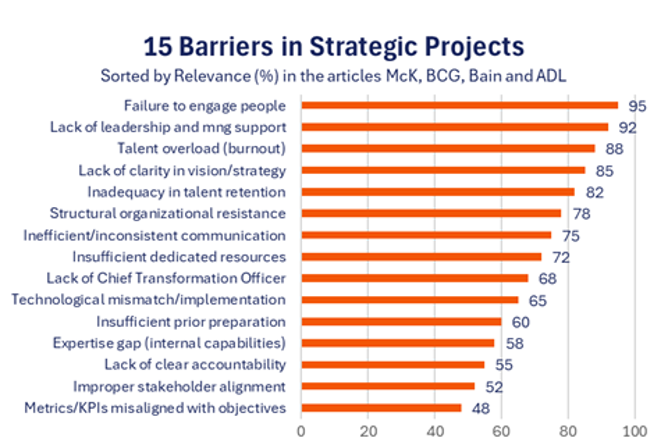
As the graph shows, the past 20 years have not been a sea of tranquility. But the feeling today is that we live in a much more turbulent, unpredictable environment, marked by major global changes and a major disruption from the technological democratization of AI. The impact on our businesses is significant, and the agility of organizations in dealing with these changes will separate winners from losers. It is no longer a question of 'if' a strategy or project will work. It's a matter of survival.
The Experience We Learned is Currently Changing
If, according to McKinsey, 70% of change projects don't work, that means only 30% do. If, according to Bain, 88% of projects do not achieve their planned results, then only 12% achieve their objectives. If, according to Arthur D. Little, 71% of companies set inadequate deadlines in response to contextual changes, such as regulations and competition, then only 29% have planned their transformations properly.
There have always been winners in organizational transformations. In my consulting career, I have lived through several of them. But the challenge is growing. External changes that used to take a few years now happen every year, then every month, and today, with AI, we need to get used to changes in weeks. For any insight you believe is original, a million people are coming up with the same idea at the same moment as you, and they are all somehow AI byproducts. All of this is happening very fast.
Small businesses are more agile and better adapted to this environment than larger organizations, but they are chaotic and lack resources. Large companies have resources and are organized, but they must follow rules and regulations. They often involve multiple cultures. The decision-making process is slower. And medium-sized companies are often young organizations, in between, and simultaneously subject to issues faced by both small and large organizations.
If we don't think of something different for companies, the above bad statistics will remain the same as they have been for the last 20 years: only 30% of projects will succeed, only 12% will achieve their objectives, and only 29% will successfully plan their strategy.
Improving the Statistics by Providing Greater Agility in Making Change Happen
Every commander-in-chief of an organization understands the difference between a calm sea, a rough sea, and a heavy sea. Risk grows exponentially as the environment becomes more turbulent, and so do the opportunities. We need, in addition to traditional methodologies, tools to address the biggest barriers to change (please see the graph above again): People.
I'm not advocating for, nor do I believe in, the automation of all processes across organizations in a Matrix-style manner. However, it is clear that human beings will increasingly engage in more valuable activities with less hierarchy, and that relationships among people will always be essential to business management. After all, customers of businesses are people. People will remain the ultimate focus of any business.
People acquire competencies and skills through years of study and professional experience. They have manual and intellectual abilities, whether innate, acquired, or both, that help them enhance their competencies and skills in their work. And they have Behaviors that form the basis of their relationships with others and how they deal with the challenges that come up.
Competencies, skills, and abilities can be easily identified by both employees and the organizations they work for or will work for as candidates. Competencies and skills can evolve through training programs, helping people qualify for new challenges. For those who want to grow, Competencies and Skills will grow as well.
Rethinking Behaviors in Practical Terms
Here is the key to improving results and agility in organizational change. We need to add an essential component to the equation above for competencies, skills, and abilities: a better understanding of how to manage Behaviors.
The vast majority of leaders delegate this management to HR, failing to examine the individual behaviors of their team members and to reflect on the behaviors required for each position in their organization. Worse, they don’t seek greater alignment between Natural Behavior, which individuals naturally express and develop, and the Position Behavior required for the function they occupy.
Think of the best salesperson you know, and put them in charge of the company's accounting; vice versa, put the accountant in sales, assuming that both have the skills and abilities to perform both functions.
The behavioral adaptation effort for both professionals will be tremendous, quickly consuming all their physical and mental energy every day. This consumption will manifest as irritability, create doorways for mistakes, damage relationships, increase tensions, and reduce expected performance. If your focus has been on people's emotions at the expense of understanding behavior, here you are, getting the worst of both.
Now, change their sales and accounting processes by automating them with AI agents, and update business management processes, including team members' processes. What was already difficult to manage becomes a barrier to change, impossible to overcome.
Let's get deeper. Think about the last time you talked about someone's behavior; most likely, it was about what that person did not do, say, or decide correctly. Most often, instead of managing behavior, we complain about them. When behaviors need to change, they become the main barrier to success in a planned transformation, whether to guard the company against competitors or to capitalize on market opportunities.
Some organizations, in their planning processes, define expected values - such as Commitment to Results, Customer Centric, or Ownership Mindset - that are intended to shape long-term culture. If you read them carefully, you will see that these expected values are generic. Everyone agrees with them, but they leave room for individual interpretation. These values help, in some way, to focus people's attention, but they do not affect daily behaviors and do not bring about the necessary changes within the expected deadlines.
The Imperative of Managing Behaviors in the Workplace
Should we add another challenge? Understanding each person’s uniqueness, including their behavior, is inherently and humanly biased. I learned it the hard way as a manager. I also learned it by refining my behavioral skills over the last ten years using GRI’s adaptive profiles, which have successfully challenged my judgment, thanks to their accurate representation and measurement of behavior.
If you are a parent with more than one child, you know what I am saying. Their behavior is markedly different from one another, despite all the education, dedication, daily routines, and resources you have provided them.
Aligning natural behaviors with the position behaviors required to assume a company’s important tasks is critical. If a function demands social skills and frequent communication with new people, there is no point in assigning someone who takes time to connect with strangers, is cynical, and highly critical. If a role requires seeking consensus, placing someone who wants to command and have authority in it will not work either.
An organization that is unbalanced in terms of Behaviors will face greater challenges in implementing changes; stress will increase, emotional temperature will rise, and performance will be negatively affected.
As the change happening today is more radical and happening faster, amid an unpredictable world, if you do not manage behaviors professionally, management consultancies will continue to publish articles highlighting failures. The choice is yours.
Here is the invitation: learn more about managing your company’s behaviors and get organized to support its transformation. Reach out to GRI’s professional network. We want to help you, too!
André LitGRI Managing Partner Brazil
Latest Articles
Groupama Successful Transformation in Romania: The GRI, Catalyst for Profound Change
The history of Groupama in Romania is an eloquent testament to resilience, strategic vision, and the transformative impact of innovative management tools. Arriving at the...
Hybrid Work: A Management Revolution
The COVID-19 pandemic has acted as an unprecedented catalyst, radically transforming our approach to work. What was once a marginal practice has become the norm for many...